Mobile Apps
Cross platform vs native apps: which should you build?
Cross platform vs native comes down to one trade-off. A cross-platform app is built once and runs on both iPhone and Android, which usually saves time and money. A native app is built separately for each platform, which gives the deepest access to each phone's newest features. For most first apps, cross-platform is the better place to start.
This guide explains what each approach means, what it does to your costs, the cases where native really is worth paying for, and how to decide for your own app.
What is a native app?
A native app is written in the platform's own language with its own tools: Swift with Xcode for iPhone, and Kotlin with Android Studio for Android. To be on both platforms, you build two separate apps, usually with two developers or two teams, and keep both up to date.
The benefit is direct access to everything the platform offers, often on the day Apple or Google releases it. The cost is that nearly every feature, fix and test happens twice.
What is cross-platform app development?
Cross-platform app development means building one app, from one codebase, that runs on both iPhone and Android. The three main options in 2026 are Flutter, React Native and Kotlin Multiplatform. Each produces a real app installed from the App Store and Google Play, not a website inside an app.
- Flutter, managed by Google, uses the Dart language. According to its documentation, it doesn't rely on web views or the platform's own widgets and draws the interface with its own engine.
- React Native, maintained by Meta, uses JavaScript. Its code renders to native platform interface components.
- Kotlin Multiplatform, from JetBrains, shares code between Android and iOS. Since May 2025, its Compose Multiplatform tool for sharing the interface on iOS has been marked stable.
Older "hybrid" apps were different: they wrapped a website in an app shell, which is why they often felt slow. Modern cross-platform frameworks compile to proper apps. We compare the two most popular ones in Flutter vs React Native.
Cross platform vs native: the differences that matter
| Cross-platform | Native | |
|---|---|---|
| Codebases | One | Two (iPhone and Android) |
| Team | One developer or team can cover both | Usually a specialist for each platform |
| Each new feature | Built and tested once | Built and tested twice |
| New iOS and Android features | Sometimes need extra platform code until the framework supports them | Available straight away |
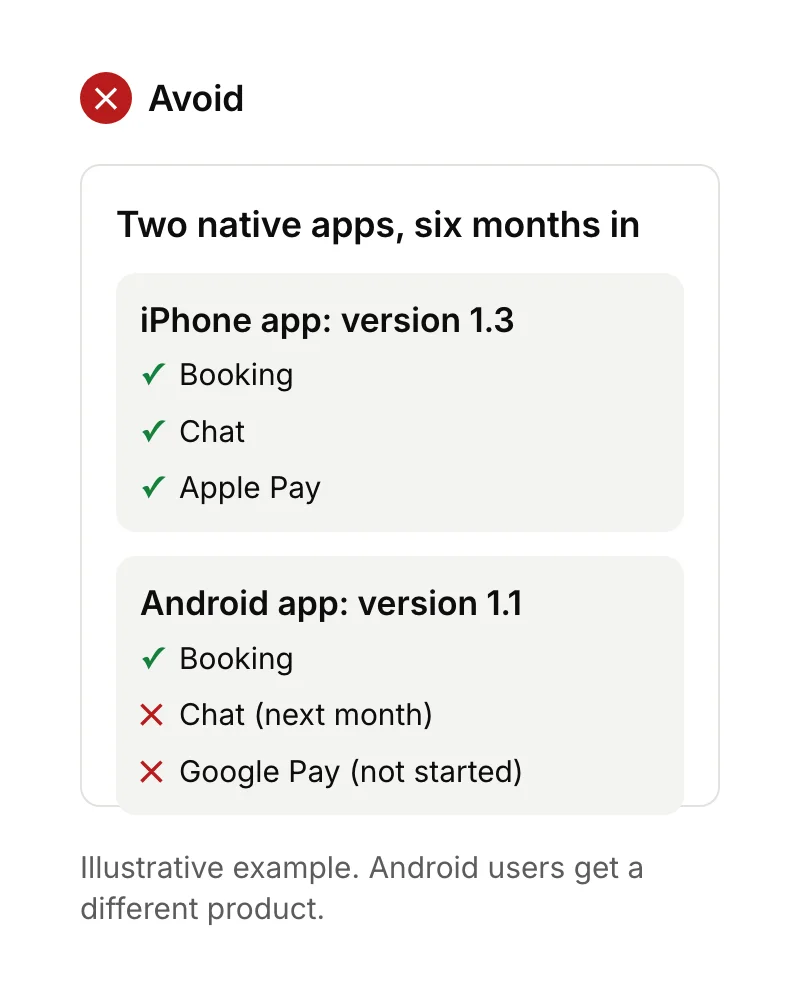
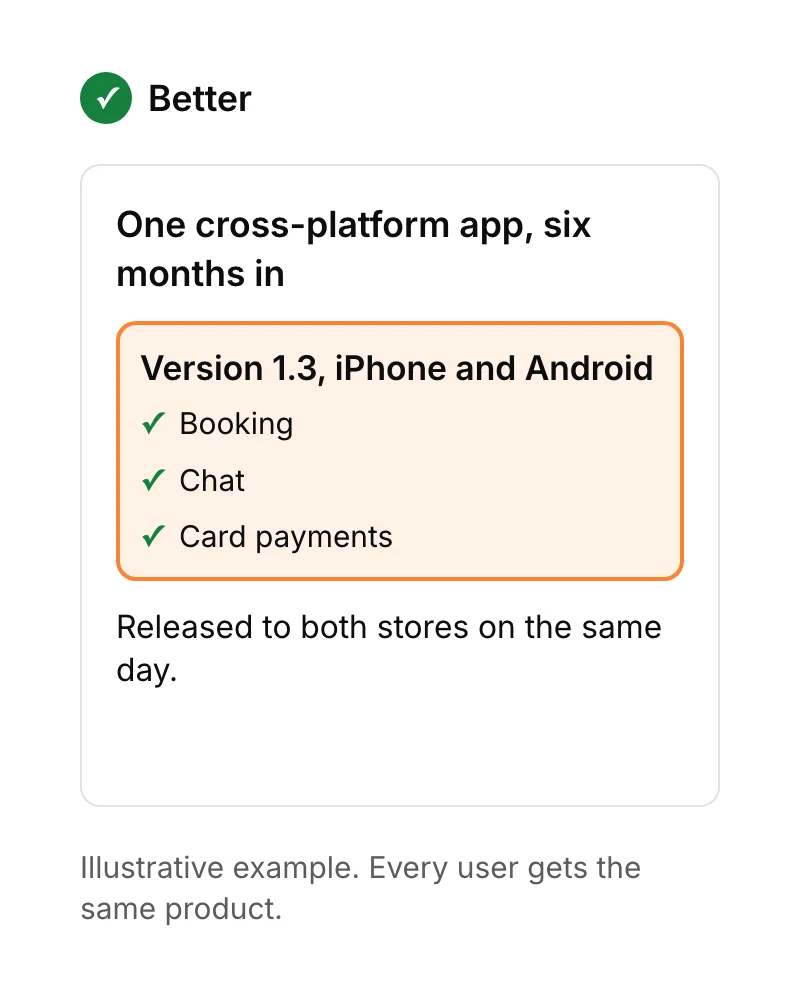
| Same features on both platforms | By default | Only if both teams keep pace |
| Web or desktop later | Possible with Flutter from the same code | A separate project |
Is cross-platform cheaper than native?
Cross-platform app development is usually cheaper than building two native apps, but not because the developers cost less. UK contract day rates for Flutter, React Native, iOS and Android developers are all in the same range. The saving comes from building, testing and maintaining most features once instead of twice.

It doesn't halve the bill either. Design, the backend (the server and database behind the app) and the work of releasing to both stores are needed whichever way you build. Our guide to how much it costs to make an app shows where the rest of the money goes.
When is native worth it?
Native is worth the extra cost when the app's main value depends on something the platform does best: augmented reality, heavy 3D, unusual hardware, or deep use of new iOS and Android features on launch day. It also makes sense if you already have a large native app and team.

For everything else, the cross-platform route gets a first version in front of users sooner with one team, which matters more to a new product than small differences in performance.
Can you mix native and cross-platform?
Yes. Cross-platform apps can include native code for the parts that need it. For example, Flutter can embed native views such as Google Maps inside its own screens, and Kotlin Multiplatform can share business logic while each platform keeps a native interface. So choosing cross-platform now doesn't lock you out of native features later.
What we recommend for a first app
For most founders, we recommend one cross-platform app, built with Flutter, as a small first version. It keeps the team and the budget small, puts the same product in front of every user, and leaves room to add native code if your data later shows a real need. Scouts Capital, Motion Shield, Mindful You Meditations and VIIO were all built that way.
If you're not sure where your app falls on cross platform vs native, tell us what it needs to do and we'll say honestly whether native would serve you better. You can read how we work on Flutter app development, or plan the smallest first version with the MVP development process.
Sources
- Flutter, FAQ. Checked 15 September 2026.
- React Native, reactnative.dev. Checked 15 September 2026.
- JetBrains, Compose Multiplatform 1.8.0 released, May 2025.
- IT Jobs Watch, contract rates in the UK for React Native, Flutter, Android Developer and iOS Developer, six months to 14 and 15 September 2026.