Mobile Apps
Flutter vs React Native: which should your startup choose?
Flutter vs React Native is a close contest. Both let one team build an iPhone and Android app from a single codebase, both are free and open source, and UK contractors for each charge similar day rates. Choose React Native if your team already writes React for the web. Choose Flutter if you want one design that looks the same everywhere, including web and desktop.
A note on bias: we build almost all our apps with Flutter. This guide still says plainly where React Native is the better choice, because picking the wrong framework costs a founder far more than it costs us.
Flutter vs React Native at a glance
| Flutter | React Native | |
|---|---|---|
| Made by | Meta | |
| Language | Dart | JavaScript or TypeScript |
| How it draws the screen | Its own rendering engine | Each platform's native components |
| Platforms | iOS, Android, web, Windows, macOS and Linux | Mainly iOS and Android |
| Well-known apps | Google Pay, Google Earth, BMW, Virgin Money, Headspace | Facebook, Instagram, Microsoft Teams, Amazon Shopping, Shopify |
| UK contract median day rate | £470 | £500 |
How do Flutter and React Native work?
Flutter and React Native both turn one set of code into apps for iPhone and Android, but they draw the screen differently. Flutter paints every pixel with its own engine, so the app looks identical on both platforms. React Native translates your code into each platform's real buttons, lists and menus, so the app looks native by default.

Neither approach is better in general. A brand-led consumer app often wants the Flutter result: the same design everywhere. An app that should feel exactly like the rest of the phone suits React Native. Both have improved a lot recently. For example, React Native's rebuilt internals, which it calls the New Architecture, have been on by default since version 0.76 in October 2024.
Flutter advantages and disadvantages
Flutter's main advantage is consistency: one codebase and one design across mobile, web and desktop. Its main disadvantage is that it uses Dart, a language fewer developers know, so there are fewer Flutter contractors to choose from.
- Advantage: one design everywhere. What your designer draws is what users see on every phone, with no platform surprises.
- Advantage: more than mobile. The same code can also run on the web and on Windows, macOS and Linux.
- Advantage: fast to change. Stateful hot reload shows code changes in the running app without restarting it, so design tweaks are quick.
- Disadvantage: a smaller hiring pool. IT Jobs Watch found 18 quoted Flutter contract rates in six months, against 61 for React Native.
- Disadvantage: not for content websites. Flutter's own documentation says text-rich content such as blog articles suits ordinary web pages better, so use Flutter web for app-like tools, not your marketing site.
React Native advantages and disadvantages
React Native's main advantage is JavaScript: web developers can learn it quickly, and a React web team can share skills and some code with the app. Its main disadvantage, in our experience, is that apps relying on many community libraries can need more work to keep up to date.
- Advantage: a familiar language. JavaScript and TypeScript are far more common than Dart.
- Advantage: looks native. Real platform components mean standard iOS and Android behaviour comes for free.
- Advantage: big users. Meta, Microsoft, Amazon and Shopify all list apps built with it.
- Disadvantage: two looks to design for. Because controls look different on each platform, test the design on both.
- Disadvantage: upgrades can take effort when an app depends on many third-party packages.
Is Flutter or React Native cheaper to hire?
Flutter and React Native contractors cost about the same in the UK. In the six months to mid-September 2026, the median contract day rate was £470 for Flutter and £500 for React Native, according to IT Jobs Watch. The bigger difference is supply: there were more than three times as many React Native rates quoted.

Day rates don't decide what your app costs, though. The number of days does, and that depends on how much you build. Our guide to how much it costs to make an app shows how a quote adds up.
Which should your startup choose?
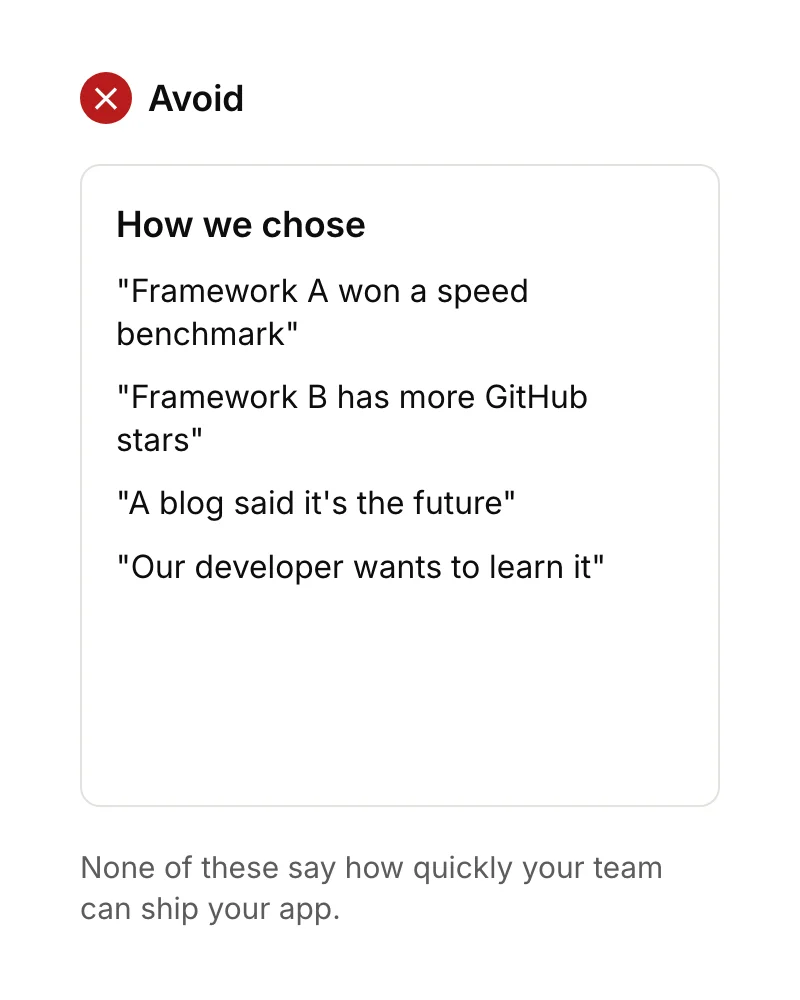
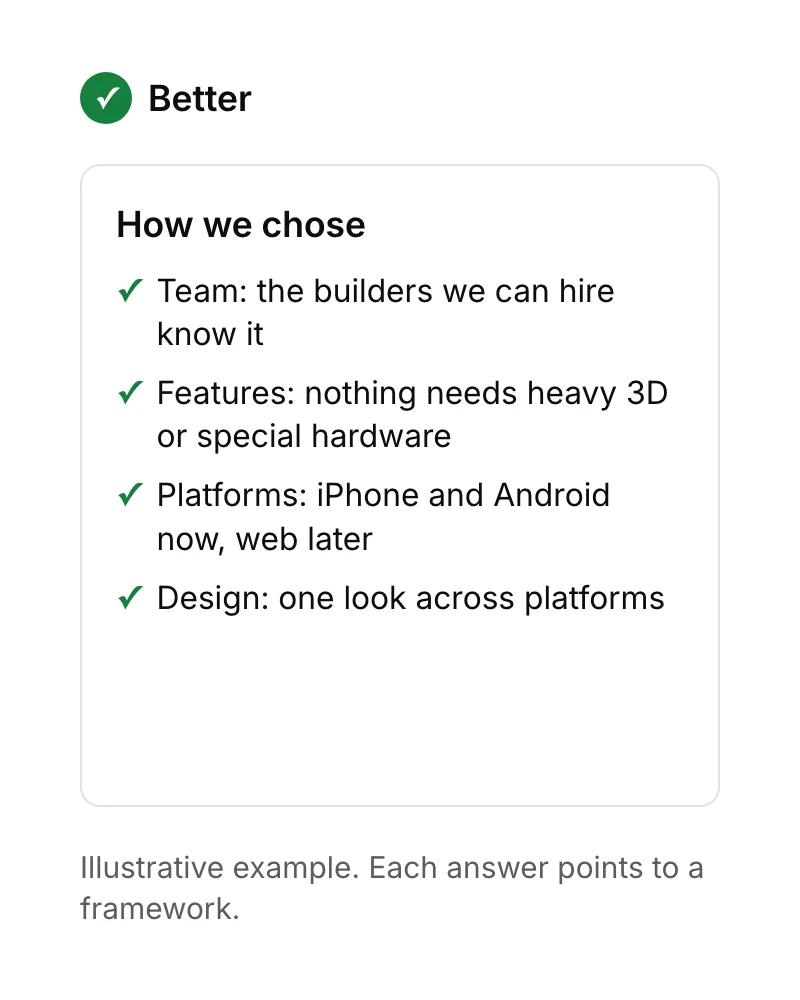
Both frameworks can build most first apps well, so settle Flutter vs React Native with your own situation, not with benchmarks. Three questions settle it for most founders.

Is Flutter good for startups?
Flutter is a good choice for most startups building a first app for iPhone and Android. One codebase keeps the team small, one design keeps things simple, and the same code can grow to web or desktop later. It's less suited to apps built around heavy 3D, augmented reality or unusual hardware, or where a large native app already exists.
That's why it's what we mainly use. Scouts Capital, Motion Shield, Mindful You Meditations and VIIO were all built with Flutter. The wider choice between one codebase and two native apps is covered in cross-platform vs native, and you can see how we work on Flutter app development.
Can you switch from one to the other later?
Yes, but it means rebuilding the app's screens and logic, so treat it as a new project. Your backend (the server, database and admin tools) can usually stay as it is. That's another reason to decide Flutter vs React Native on your team and features rather than trends, because a well-chosen framework rarely needs replacing.
Sources
- Flutter, FAQ and Supported deployment platforms. Checked 15 September 2026.
- Flutter, Web support. Checked 15 September 2026.
- Flutter, Showcase. Checked 15 September 2026.
- React Native, reactnative.dev and Showcase. Checked 15 September 2026.
- React Native blog, React Native 0.76: New Architecture by default, 23 October 2024.
- IT Jobs Watch, Flutter contract rates, UK and React Native contract rates, UK, six months to 14 and 15 September 2026.