Startup How To
How to check if your app idea exists, and what to do next
Here's how to check if your app idea exists: search the App Store and Google Play with words that describe the problem, search Google and Product Hunt, read competitors' two and three-star reviews, then check the UK trade mark register and Companies House for your name. It takes about an hour. Finding similar apps usually means demand is real.
This guide covers each search, what to do when you find competitors, and how to validate an app idea with real people before you pay anyone to build it.
How to check if your app idea exists in 5 searches
Most founders search once, find nothing, and assume the idea is new. Five different searches give a far more honest picture, because each one finds a different kind of competitor.

- The App Store and Google Play. Search three or four phrases that describe the problem, and look past the first few results.
- Google. Search the problem plus "app", and the problem on its own. Many solutions are websites, not apps.
- Product Hunt and startup directories. These surface new and small products that don't rank in app stores yet.
- Competitors' reviews. Read the two and three-star reviews of the top results. This is where the gaps are.
- Trade marks and company names. The UK government's trade mark search shows whether a similar brand is registered, and Companies House lets you check if a company name is available.
Search for the problem, not your app's name
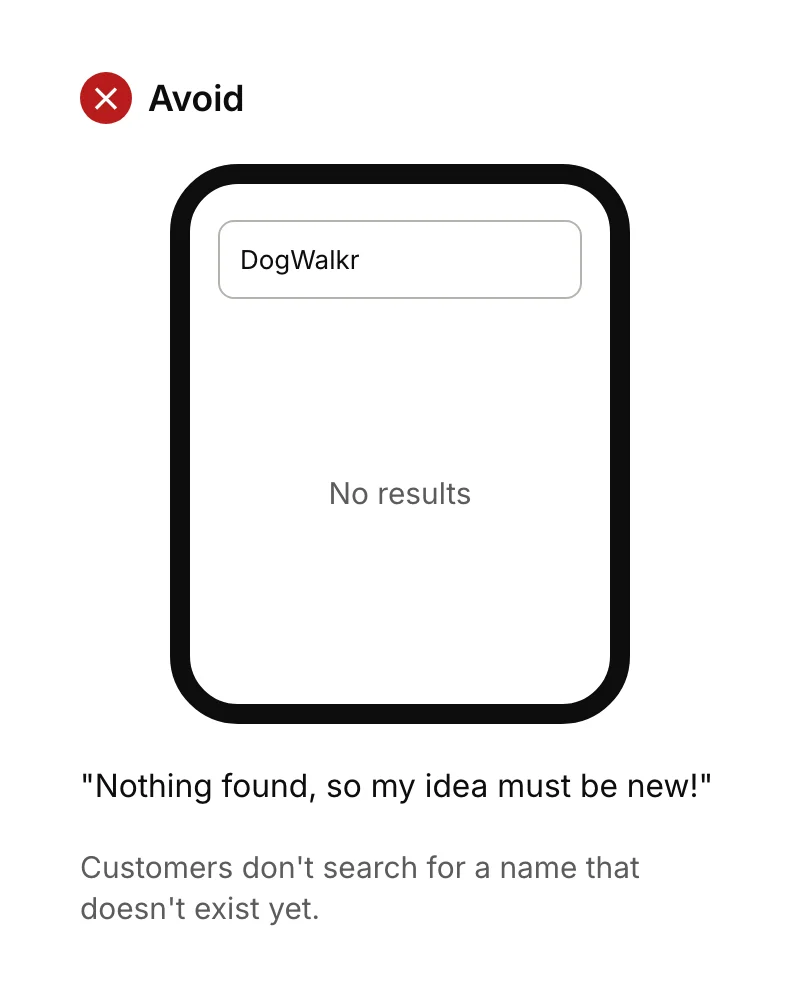
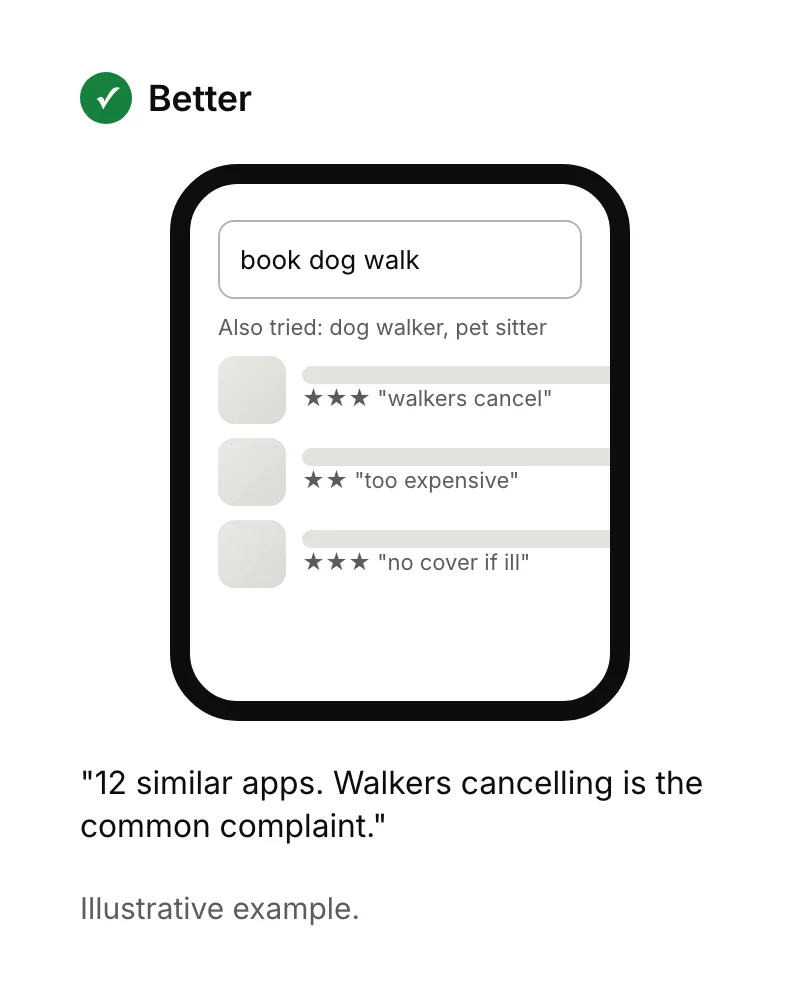
People searching an app store type what they need, not what you've called your product. So search the way a customer would: "dog walker", "book dog walk", "pet sitter". Searching your made-up app name will almost always return nothing and tell you nothing.
Read competitors' reviews to find the gap
Competitors' two and three-star reviews are the most useful research you can do for free. One-star reviews are often about a single bad day, and five-star reviews rarely say what's missing. The middle reviews come from people who want the app to work and explain exactly what stops it.
Look for patterns across several apps:
- The same complaint from different users, such as "walkers cancel at the last minute".
- Features people ask for again and again.
- Complaints about price or a recent change ("it used to be simple").
- Groups of users the app ignores, such as a city, a profession or an age group.
Write each pattern down. If one keeps appearing and nobody fixes it, that's a strong place to start.
What if your app idea already exists?
If your app idea already exists, that's usually good news: it proves people have the problem and use apps to solve it. You don't need a new idea. You need a clear reason for some customers to choose you, and a way to reach them that the existing apps don't use.
| Approach | Example |
|---|---|
| A narrower audience | Dog walking for owners of reactive or nervous dogs |
| Fix the common complaint | Guaranteed cover when a walker cancels |
| Simpler | Book in three taps instead of filling in a profile |
| Local | Checked walkers in one city, with a real local team |
| A different price model | A monthly plan instead of paying per walk |
What rarely works is "the same, but better". Users won't switch for small improvements, so pick one difference that matters a lot to one group.
How to validate an app idea before building
Knowing how to check if your app idea exists tells you about competitors. Validation tells you about customers. To validate an app idea, get evidence that real people have the problem and will act to solve it, before you pay for development. The cheapest ways are conversations with potential users, a simple landing page that asks people to sign up, and doing the service by hand for a few customers first.
Talk to 10 potential users, the right way
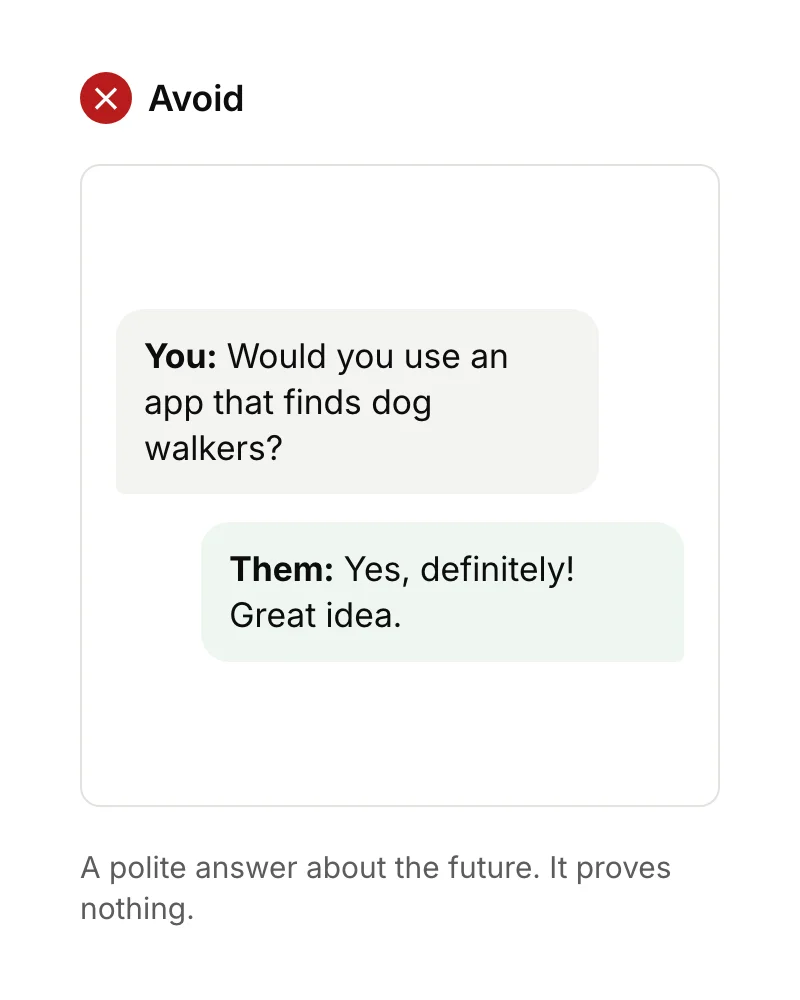
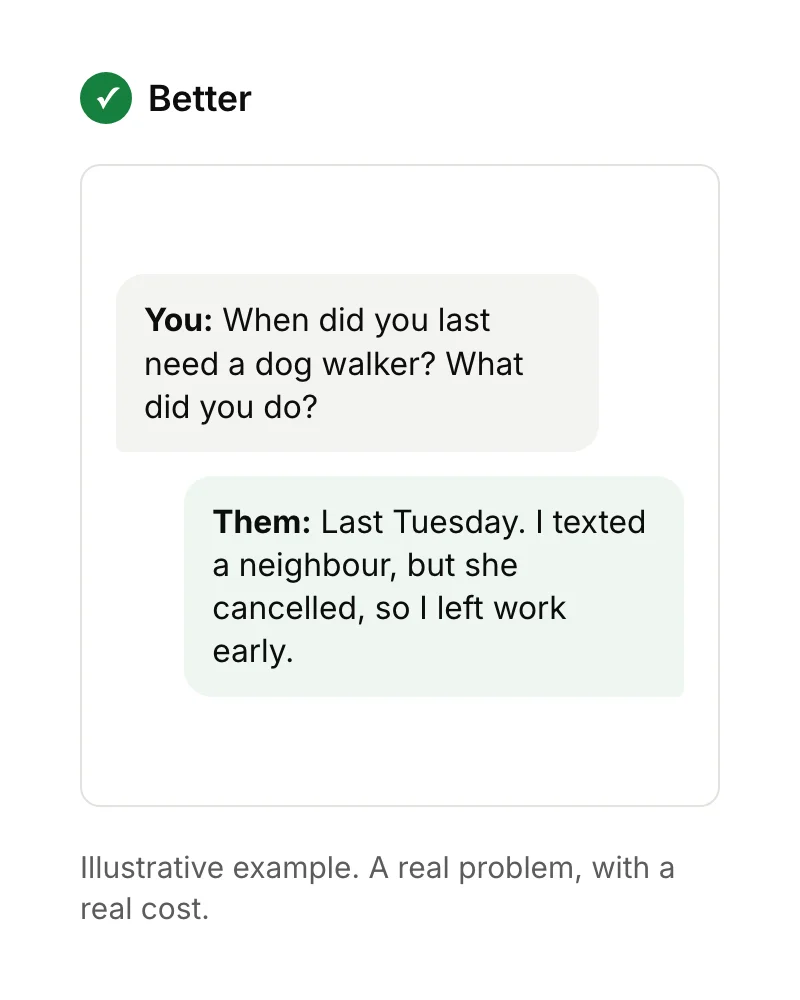
Ask about their past behaviour, not your idea. People are polite about ideas but accurate about what they did last week. Rob Fitzpatrick's short book The Mom Test is built on exactly this point, and it's worth an evening before your first conversation.
Test a business idea with a landing page
A one-page website that explains the benefit and asks people to join a waiting list tests demand without building anything. Send a small amount of targeted traffic to it and count sign-ups. Our guide to what a landing page is shows what to put on it.
Do it by hand first
Before building a booking app, take bookings over WhatsApp and a spreadsheet for a few weeks. If people keep booking and paying, you've validated the business, and you know exactly which steps the app needs to automate.
How do you know if your app idea is viable?
An app idea is viable when five things are true: people have the problem often, they already spend time or money on it, you can reach them affordably, there's a clear way to make money, and a useful first version fits your budget. If one is missing, fix that before you build.
- Frequency: a weekly problem supports an app far better than a yearly one.
- Existing spending: people already pay, or put up with a messy workaround.
- Reach: you know where these people gather, online or offline.
- Money: see how apps make money for the options.
- Budget: see how much it costs to make an app.
Check the name before you fall in love with it
The same searches that show how to check if your app idea exists work for names too. Run your chosen name through the UK trade mark search, the Companies House name checker and both app stores before you pay for a logo. Having to rebrand after launch is expensive and confusing for early users. Our guide on how to protect an app idea covers registering the name once you've chosen it.
When the evidence says go, the next step is to plan the smallest first version, covered in the MVP development process. If you'd like a second opinion on your idea, our Flutter app team gives a free quote within 48 hours of a first call.
Sources
- GOV.UK, Search for a trade mark. Checked 15 September 2026.
- Companies House, Company name availability checker. Checked 15 September 2026.
- Rob Fitzpatrick, The Mom Test. Checked 15 September 2026.